Ascot Park (Raceway)
| Ascot Park | |
|---|---|
 Ascot Park (Raceway) (circa 1986) | |
| Coordinates | 33°51′52″N 118°17′21″W |
| Capacity | 8,000 |
| Landlord | Max Ziegler |
| Owner | J. C. Agajanian (1976–1984) |
| Opened | 1957 |
| Closed | November 22, 1990 |
| Former names |
|
| Major events | |
| outer oval track | |
| Surface | dirt |
| 0.50 mi (0.8 km) | |
| Turns | 4 |
| inner oval | |
| Surface | dirt |
| Length | 0.25 mi (0.4 km) & Figure 8 course |
Ascot Park, first named Los Angeles Speedway and later New Ascot Stadium, was a dirt racetrack located near Gardena, California. Ascot Park operated between 1957 and 1990 and was situated at the intersection of Vermont Avenue and 182nd Street, adjacent to the Harbor Freeway and between the Interstate 405 and 91 freeways. During its operation, Ascot Park was one of the most active motorsports venues in the United States and hosted a wide range of two- and four-wheel racing disciplines. Ascot Park became a major fixture in American motorsports through its long association with promoter J.C. “Aggie” Agajanian and his family who over its 33-year history, staged thousands of events sanctioned by organizations including the United States Auto Club (USAC), the National Association for Stock Car Auto Racing (NASCAR), the American Motorcyclist Association (AMA), the Figure Eight Association of Racers (FEAR) and the California Racing Association (CRA). Many IndyCar, AMA and NASCAR champions started their career there including the launch of world renown daredevil, Evel Knievel. The USAC Midgets Turkey Night Grand Prix was held at Ascot Park from 1960 to 1990 and became the last ever race run at the track.
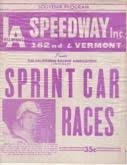
Los Angeles Speedway
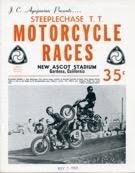
New Ascot Stadium
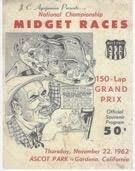
Ascot Park


History
The first racetrack bearing the Ascot name, Ascot Speedway, operated in Los Angeles from 1907 to 1919.[1] Located at Slauson Avenue and Central Avenue (now Avalon Boulevard), it originated as a horse racing facility before evolving into a one-mile dirt oval for automobile and motorcycle racing. The site was later redeveloped as a Goodyear tire plant.
A second venue, Legion Ascot Speedway, opened in 1924 in Alhambra, California. Owned by the American Legion, it operated until 1937.[2] The track gained notoriety for a series of fatal accidents and was closed following the death of driver Al Gordon and his mechanic, Spider Matlock.[1] The track was deliberately set on fire by a former employee, who was distraught over the numerous deaths which resulted in its closure. The land was later redeveloped for residential and educational use.
The third facility, Southern Ascot, opened in 1938 in South Gate, California, at Atlantic and Tweedy Boulevards. Originally known as Southern Speedway, it hosted midget and sprint car racing on a half-mile dirt oval.[1] Operations ceased during World War II.
The modern Ascot Park originated as Los Angeles Speedway, constructed in 1957,[3] on the site of a former city dump. It was built less than 1 mile (1.6 km) from the former site of Carrell Speedway, which had been closed in late 1954 to make way for the Artesia Freeway. Property owner Max Ziegler leased the land to Bill McKay and Walt Mahony, who developed the facility.
The track was renamed to New Ascot Stadium in October 1958 as part of a management change following the closure of Carrell Speedway[4] and was re-engineered to allow three-wide racing on its straightaways which allowed J.C. Agajanian to begin promoting big time championship auto and motorcycle racing there and by 1961, the track gained notoriety and assumed the name Ascot Park until its closure in 1990.
In 1976, Agajanian took ownership of the lease and invested approximately $1 million in facility upgrades. The installation included state-of-the-art lighting, higher & stronger catch fences, reinforced crashwalls, new restrooms, additional concession stands, surrounding billboards, electronic scoreboard, modernized sound system, city-supplied water, natural gas, an updated electrical main panel, transformers, high-voltage cables, and renewed bleachers.
Under Agajanian’s leadership, Ascot Park became one of the most active racing venues in the country. The facility featured a half-mile dirt oval, a quarter-mile oval, an eighth-mile oval, a figure-eight course, a motocross course, a TT course and an off-road layout.
Ascot hosted weekly events such as CRA Sprint Cars, USAC Midgets, AMA Flat Track motorcycle races, NASCAR stock car races, FEAR Figure 8 races, CMC Motocross races plus special events like Demolition Derbies, Dune Buggies, Big Rig Trucks, Mud Bogs, Monster Trucks and the annual USAC Turkey Night Grand Prix midget race on Thanksgiving.
With seating for 8000, open 5-nights-a-week, 8 months of the year, Ascot Park became known as the busiest racetrack in the U.S. With regularly scheduled National Championship races and its heavy radio advertising, Ascot Park became a celebrated motor racing venue. J.C. Agajanian Jr.’s radio advertisements ended with the phrase "Ascot in Gardena, where the Harbor, the San Diego and the 91 freeways collide!". J. C. Agajanian promoted major races at the venue until his death in 1984. His three sons, Cary, J.C. Jr. & Chris continued to operate the venue.


J.C. Agajanian looking over his track. The Agajanians proved to be masters of promotion.
After the death of J.C. Agajanian, Cary Agajanian assumed leadership and all legal matters while, J.C. Agajanian Jr. handled advertising and trackside commentary, and Chris Agajanian continued to manage the development and daily operations. In 1984, further development on the northern portion of the 44-acre property began with the creation of the Ascot Competition Center, which included corporate offices, an arcade, a BMX track, radio-controlled racing facilities, Ascot Slic Trac (a slippery concrete oval ), and Ascot South Bay Stadium, a 5,000-seat speedway motorcycle venue that was televised on Agajanian’s “Speedway America” program.
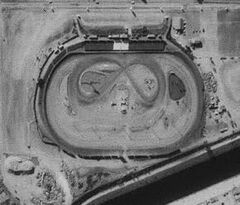
BEFORE
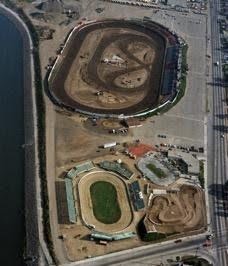
AFTER


Sprint Car Racing

Sprint car racing was a cornerstone of Ascot Park. The track’s clay surface and semi-banked turns allowed sustained high-speed racing with 900 horsepowered cars competing side by side at speeds exceeding 140 mph. Drivers had to employ a unique technique, turning the car sideways and backing it into the corners while skillfully managing tire spin to maintain control of the car. Ascot regularly hosted CRA Sprint Car and USAC events. Numerous drivers who later achieved success at the Indianapolis 500 and Daytona 500 competed at Ascot, including Mario Andretti, A.J. Foyt, Parnelli Jones, Rick Mears, Bobby Unser, Al Unser, Jeff Gordon, Dale Earnhardt, Neil Bonnett, and Darrell Waltrip.
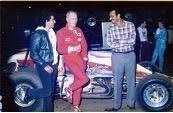
Chris & Cary Agajanian with Paul Newman
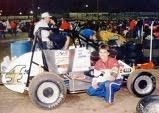
Jeff Gordon at Ascot


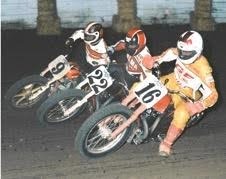
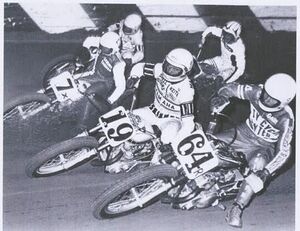
Ascot Park known as the fastest Half-mile dirt oval in the nation, earned the nickname “Temple of Speed”. Its challenging clay surface became extremely tacky as the sea air rolled into the area. This resulted in adhesive traction which experts described as spectacular yet perilous. Ascot Park became internationally known for its AMA flat track and TT (Tourist Trophy) motorcycle racing, earning a reputation as one of the fastest and most challenging dirt tracks in the sport. Weekly “Flat Track” motorcycle races were held for decades. Ascot hosted AMA Grand National Championship events from 1959 through 1990.
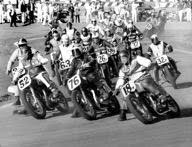
Flat track motorcycles displaying Ascot’s massive traction
Start of a 100 lap TT race


Ascot Park served as a proving ground for some of the greatest riders in motorcycle history. Notable riders like Dick Mann, Sammy Tanner, Jay Springsteen, Kenny Roberts, Wayne Rainey, Eddie Lawson, Doug Chandler, Bubba Shobert, Ronnie Jones, Scotty Parker, and Gene Romero.
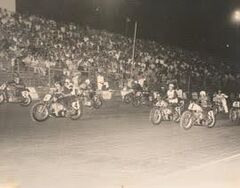
July 25, 1959, first AMA National, Sold-Out
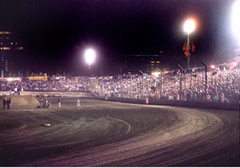
Last AMA National, September 29, 1990, 11,000 fans


Yamaha’s connection to Ascot Park
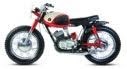
1963 YAMAHA ASCOT SCRAMBLER

In 1963, Yamaha Motor Corporation introduced the Yamaha Ascot Scrambler, capitalizing on the success of Yamaha motorcycles in AMA novice competition at Ascot Park. The 250cc, twin cylinder Yamaha Ascot Scrambler was in production from 1962 to 1967 and reflected the track’s influence on the American motorcycle racing culture.
Honda’s connection to Ascot Park
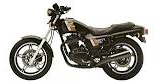
1963 YAMAHA ASCOT SCRAMBLER

Honda’s racing presence in the United States developed in part through competition at Ascot Park. In 1969, Cycle World reported on Honda motorcycles designed specifically for Ascot competition. Honda later achieved championship successes at the track. Even after Soichiro Honda's retirement, Honda Motor Co. named two production motorcycles after the venue, the Ascot FT500 and Ascot VT500. Both were featured in Honda’s national television advertising campaigns during 1982 and 1983, reflecting Ascot Park’s cultural importance.[5]


J.C. Agajanian with Soichiro Honda
NASCAR Stock Cars / Super Modifieds
NASCAR Stock Car races were held every Sunday night at Ascot Park since its beginning. The track was responsible for more NASCAR memberships than any track in its day. Three NASCAR Cup Series events were held at the track. The first in 1957 event was won by Eddie Pagan. The second, a 500-lap event was on the quarter-mile track, and won by Parnelli Jones. The final Cup Series race was held in 1961 on the half-mile track when Eddie Gray lapped the field for the win.[6]


NASCAR’s Neil Bonnett, Darrell Waltrip & Dale Earnhardt at Ascot
Ascot Park also became known for large-scale enduro races, often featuring over 100 participating vehicles.


Figure 8 Racing & Demolition Derbies
Figure-eight racing was among Ascot’s most well-liked spectator events and was held regularly on Sunday nights. The intersecting track layout created deliberate contact between vehicles, contributing to its popularity.


Racers competing on an " 8 " shaped, intersecting track.
Demolition derbies were staged as special events, featuring multiple full-size vehicles crashing into each other until only one remained operational and declared the winner.


Demolition drivers purposefully crash into each other until the last car running.
USAC Midgets
Ascot Park hosted weekly USAC Midget racing and major national championship events. The first 100-lap National Championship Midget race at Ascot was held in 1958, won by George Amick. ESPN televised live racing from Ascot on their Thursday Night Thunder broadcasts from 1988 to the track's closing in 1990.
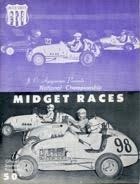
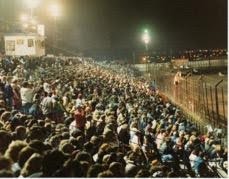
Ascot’s major events always drew huge crowds
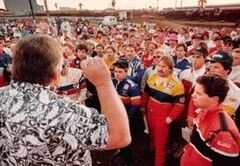
USAC official conducts a drivers’ meeting


The Turkey Night Grand Prix, first held in 1934, moved to Ascot Park in 1960 and became an annual highlight. The 50th Turkey Night Grand Prix in 1990 marked the final event held at Ascot Park and concluded more than 5,000 main events at the venue.
Evel Knievel appearances
Robert Craig “Evel” Knievel had begun performing motorcycle stunts in 1966 at fairs and carnivals. His dream was to perform on national television. In January 1967, Knievel reached an agreement with Ascot promoter J.C. Agajanian to perform a motorcycle jump over fifteen automobiles during intermission at Ascot Park on ABC’s Wide World of Sports. The performance took place on March 25, 1967, and drew an estimated 2,000 additional spectators beyond the previous year’s attendance. The performance gained Knievel international attention and widespread recognition which brought him a newly found popularity. Evel Knievel took advantage of his new fame by planning longer jumps for national television and pay per views. Ascot’s jump marked the beginning of a lasting friendship between Evel Knievel and J.C. Agajanian.


Knievel continued to appear at multiple Agajanian-promoted events.
Ascot Weekly Motocross


Ascot Park played a significant role in the development of stadium motocross in the United States. In 1969, promoters Gary and Bob Bailey organized the first stadium-based motocross event which was held at Ascot Park, departing from the sport’s traditional reliance on natural terrain courses. The new format allowed spectators to view the entire course from grandstand seating and enabled evening racing under the lights which helped develop the sport. Ascot subsequently hosted weekly motocross events, making it accessible to a broader audience, including novice, amateur and professional riders.


AMA Hall of Famers John DeSoto & Jim Pomeroy
The Agajanians also organized high school motocross competitions, contributing to the development of several riders who later competed at professional levels. Ascot Park hosted its final night motocross race on November 2, 1990.
AMA Weekly Speedway Races


AMA weekly speedway motorcycle races were conducted at Ascot South Bay Stadium, a 5,000-seat, 1/8-mile oval located adjacent to Ascot Park’s main track. The surface consisted of crushed, decomposed granite, consistent with international speedway racing standards. Races featured four riders per heat, with multiple elimination rounds leading to a final event. Speedway motorcycles are single-cylinder, 500cc, methanol-fueled machines with no brakes and single-gear transmissions. Events were broadcast nationally on Prime Ticket and ESPN through the Agajanian-produced television program “Speedway America”. Several American riders who later achieved international success competed at Ascot, including World Champions Bruce Penhall, Billy Hamill, and Greg Hancock.
Off-road Dune Buggie Racing
Ascot Park hosted off-road dune buggie racing, sanctioned by organizations including the American Desert Racing Association and Southern California Off-Road Drivers Association. The course incorporated Ascot’s TT jump, positioning competitors directly in view of the grandstands.

Several drivers who later achieved success in professional motorsports competed at Ascot during this period. One season Rick and Roger Mears claimed 14 out of 15 feature races. Rick Mears won the Ascot Sprint Buggie Championship in 1970, prior to his career in IndyCar racing, where he later won the Indianapolis 500 four times.


Steve McQueen, Chuck Norris and four-time Indy 500 winner Rick Mears at Ascot
Ascot Bicycle Motocross


During the 1980s, Ascot Park became a major venue for Bicycle Motocross (BMX) racing. The facility hosted BMX events multiple days per week and frequently attracted up to 200 participants per event, with larger national races drawing more than 1,000 riders. Ascot’s BMX program was an important contributor to the early growth of the sport in Southern California by providing structured competition for youth riders during BMX’s formative period in the United States. BMX became a prominent, two-discipline Olympic event.
Ascot Slic Trac
Ascot Slic Trac was conceived and introducedat Ascot in 1984 as a controlled-environment karting attraction. The venue featured a 330-foot polished concrete oval, bordered by an energy-absorbing crash wall and coated with a slick epoxy finish and dusted with talcum powder to promote controlled sliding.


Charlie Sheen, Nicolas Cage & Friends party at the Slic Trac
The Agajanians produced purpose-built Ascot Trackmaster go-karts constructed from lightweight polyethylene non-breakable material. The format allowed participants of varying experience levels to compete together. An unexpected benefit was driver safety for personal car control in rainy or icy conditions. The Agajanians franchised more than ten Ascot Slic Trac facilities in Japan.

Ascot Slic Trac in Japan.
Ascot Radio Control Racetrack

The Ascot Radio Control Racetrack was located outside turn four of the main track and featured oval and off-road RC courses modeled after Ascot Park. The facility included professional driver stands, a scoring tower, pit areas, work benches, spectator seating, and a public address system.
The venue hosted weekly club races, state championships, and nationally sanctioned events. An on-site retail store sold radio-controlled vehicles and components and offered instructional support for beginners.
The Agajanian brothers grew up around racing all their lives. They have been honored with many awards and inducted into multiple Halls of Fame. Led by older brother Cary, they have continued the tradition of entering racecars in the Indianapolis 500 and have added two more Indy 500 victories to the prior two their father J.C. Agajanian had achieved.
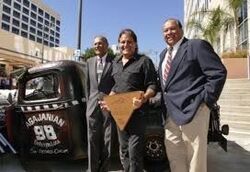
Cary, Chris & J.C. Jr. receiving L.A. Sportswalk Hall of Fame plaque
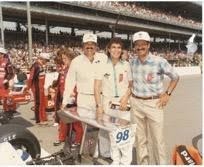
Brothers three on Starting Grid at the Indianapolis 500


Closure and redevelopment
The 50th annual USAC Turkey Night Grand Prix for midget cars became the last of more than 5,000 main events held since the track opened. Ascot Park was closed in November 1990[2] after Lillian Ziegler, the widow of property owner Max Zeigler declined to renew the Agajanian’s lease in favor of developer Howard Mann’s proposal, a project that never began. The racetrack was demolished, and after approximately eleven years of inactivity, the site is now an auto salvage and used car auction site.
Ascot Drivers that Raced in the Indianapolis 500
| A.J. Foyt Jr. | Chuck Hulse | Joe Saldana |
| A.J. Shepherd | Chuck Rodee | John Andretti |
| Al Unser, Jr. | Shorty Templeman | Johnnie Parsons |
| Al Unser, Sr. | Dempsey Wilson | Johnnie Tolan |
| Arnie Knepper | Dick Simon | Johnny Boyd |
| Art Bisch Sr. | Don Branson | Johnny Parsons Jr. |
| Bill Cheesbourg | Don Davis | Johnny Rutherford |
| Bill Homeier | Don Edmunds | Johnny White |
| Bill Puterbaugh | "Pancho" Carter | Jud Larson |
| Billy Boat | Elmer George | Larry Cannon |
| Billy Engelhart | Frank Armi | Larry Dickson |
| Billy Scott | Gary Bettenhausen | Larry Rice |
| Billy Vukovich II | Gary Congdon | Lee Kunzman |
| Bob Harkey | George Amick | Len Sutton |
| Bob Mathouser | George Snider | Lloyd Ruby |
| Bob Wente | Greg Leffler | Mario Andretti |
| Bobby Grim | Greg Weld | Mel Kenyon |
| Bobby Marshman | Jack Hewitt | Mike Groff |
| Bobby Olivero | Jan Opperman | Mike Mosley |
| Bobby Unser | Jeff Gordon | Norm Hall |
| Bruce Walkup | Jeff Ward | "Bubby" Jones |
| Bryan Herta | Jim Hurtubise | P. J. Jones |
| Bud Tingelstad | Jim Malloy | Parnelli Jones |
| Cal Niday | Jim McElreath | Ray Crawford |
| Carl Williams | Jimmy Caruthers | Rich Vogler |
| “Sonny” Ates | Jimmy Davies | Rick Mears |
| Chuck Arnold | Joe Leonard | Rodger Ward |
| Roger McCluskey | Sheldon Kinser | Tom Bigelow |
| Roger Mears | Stan Fox | Tony Bettenhausen |
| Roger Rager | Steve Chassey | Troy Ruttman |
| Sam Schmidt | Steve Kinser | Wayne Weile |
| Sammy Sessions | Swede Savage |
Movies & Shows Filmed at Ascot
The racetrack was also used in movies and TV shows like the original Gone in 60 Seconds, A Very Brady Christmas, Pit Stop, T J Hooker, and CHiPs. The track was frequently used for location filming by major Hollywood movie production studios including television networks, such as ESPN, TNN, Prime Ticket, KTLA, KTTV, NBC, KCOP, and ABC.
- Jalopy Derby 1959-1960
- Red Line 7000 1965
- The Killers 1964
- Fireball 500 1966
- Spinout w/ Elvis 1966
- The Cool Ones 1967
- Thunder Alley 1967
- Pit Stop 1969
- Little Fauss & Big Halsy 1970
- “On Any Sunday” 1971
- Gone in 60 Seconds 1974
- The Rockford Files 1975
- CHiPs 1979
- CHiPs 1980
- TJ Hooker 1982-1986
- CHiPs 1983
- Beverly Hills Cop II, 1987
- A Very Brady Christmas 1988
- Another 48 hours, 1990
- Bright Flashes 1982
- Jalopy Derby 1959–1960 TV
- Racing from Ascot 1983-1986
- Thursday Night Thunder 1988-90
- Speedway America 1984-1990
Celebrities That Came To Ascot
- Angie Dickinson
- Annette Funicello
- Brian Donlevy
- Bruce Penhall
- Charlie Sheen
- Chuck Norris
- Clint Walker
- Connie Stevens
- Dan Blocker
- David Nelson
- Dickie Smothers
- Eddie Murphy
- Elvis Presley
- Eric Estrada
- Fabian
- Florence Henderson
- Gary Wright
- Gene Hackman
- Graham Nash
- Graham Chapman
- Heather Locklear
- Ike and Tina Turner
- James Caan
- James Dean
- James Darren
- James Garner
- Jayne Mansfield
- John Cassavetes
- Keenan Wynn
- Kent McCord
- Larry Wilcox
- Lauren Hutton
- Lee Marvin
- Michael J. Pollard
- Motley Crue
- Patrick Swayze
- Nicolas Cage
- Paul Anka
- Paul Newman
- Ricky Nelson
- Robert Pine
- Robert Redford
- Rod Carew
- Roddy McDowall
- Shelley Fabares
- Stephen Stills
- Steve McQueen
- Sylvester Stallone
- The Monkees
- Toby H.B. Halicki
- William Shatner
- Wolf Man Jac
See also
- Eddie Gray (notable Ascot Park weekly series alumni)
- Christopher J.C. Agajanian
- Figure 8 racing
References
- ↑ 1.0 1.1 1.2 CECILIA RASMUSSEN (October 10, 1994). "Life--and Death--in Fast Lane at Ascot". Los Angeles Times. Retrieved November 5, 2019.
- ↑ 2.0 2.1 Glick, Shav (November 11, 1990). "End of an Era : Ascot Park to Join Southland Tracks That Have Passed Into History". Los Angeles Times. Retrieved June 8, 2016.
- ↑ Stein, John L. (February 20, 2012). "Ascot Park Reunion Set for May". Autoweek. 62 (4): 19.
- ↑ Wallace, Paul (October 18, 1958). "Motor Sports". Independent. Retrieved July 28, 2019 – via Newspapers.com.
- ↑ "Evel's Connection to Ascot". Ascot Motor Sports. June 20, 2015. Archived from the original on July 4, 2015. Retrieved June 8, 2016.
- ↑ Ascot Stadium NASCAR results, Retrieved November 27, 2007. Archived 2007-03-02 at the Wayback Machine
External links
- Ascot Park race results at Racing-Reference
- Ascot Stadium race results at Racing-Reference
- Garbell.com: Ascot Park track photos & video
- Facebook — Ascot Park Fan Page
- "Impact '66" — vintage Chevrolet sales film; one segment depicts figure 8 racing at Ascot Park.